The emotional intelligence activities are exercises or practices which help you understand and manage your own emotions, as well as recognize or know others’ emotions and influence them. You put yourself for the analysis and perception of your own emotions and feelings, as well as those of others, in a better way. Using the simple exercises, you can inculcate (develop) the ability to efficiently take care of your stress, start lasting friendships and make informed decisions and meaningful choices for yourself.
You should begin early. You may start learning EL—emotional intelligence—skills at an early age. You can use fun sessions and practical processes or tasks to learn them. You will gain a strong foundation for a lifelong pursuit of mental health and wellness. Hence, in this post, we will explore the activities, tasks, and practical tips.
Key Takeaways
Before going through the important practices, here are the points of the EI tips that you will learn in this post:
- Understand how tools of feelings, journals, emotion wheels, and story discussions develop EI strengths and traits.
- Activities create a mindfulness boost and teamwork amongst the students from the beginning.
- How the training modules raise productivity in the workplace and employees’ settings.
- Shared tasks build trust within the group, creating a powerful and essential environment.
What Is the Meaning of Emotional Intelligence Activities?
As you have already understood in the introduction paragraph, emotional intelligence is the ability to be aware of, control, and express one’s own emotions. It helps maintain interpersonal relationships with your relatives, friends, or coworkers.
Now, as for the exercise, these are simple activities that help you better understand and manage your feelings and emotional triggers. You can identify your own emotions and those of others, and, based on your perception of these factors, you can respond to others thoughtfully or positively. This is how you develop a good relationship with the help of the emotional intelligence activities for kids, youngsters and adults, as a whole.
These practices can be of different kinds, including journaling (a therapeutic tool or a safe space where you keep writing down your thoughts and feelings), breathing exercises, role-playing, group discussions and many other sessions.
All these activities help you, as well as your friends and other participants, develop self-awareness and empathy skills and understand your/their own feelings and emotions. The traits, or so to speak, the qualities, come to you and them naturally as you and they keep practising regularly.
What Are the Best Emotional Intelligence Activities for Kids?
For kids, the tasks or the activities can be practices involving feelings journals, emotion wheels, and story discussions.
In the world of EI, journals are simply therapeutic tools or safe spaces where you keep writing down your thoughts and feelings.
In these activities, the children may draw different faces expressing emotions or depicting/showing various role-play scenarios.
Using these types of activities, you can provide a background for children to build empathy, which will come naturally to them. These young learners may eventually be in a position to identify feelings and choose or react with kind responses positively and effectively.
Simple Emotional Intelligence Activities for Children
If you can arrange the appropriate activities as per their developmental stages, children will definitely benefit from the tasks and exercises. For the convenience of your understanding of the activities as per age group and the benefits from each task, here is a table:
| Activity | Age Group | Skills Built |
| Feelings Journal | 4-8 years | Self-awareness, vocabulary |
| Emotion Charades (Act/Event) | 5-10 years | Recognition, expression |
| Story Discussion | 4-12 years | Empathy, understanding |
How Do You Build Emotional Intelligence Activities for Students?
This type of EI tasks usually focus on real-life classroom scenarios, the activities that happen every day in the class. Students who participate in the activities will receive feedback on how they fared and will gain confidence. And during the participation, if they receive mindfulness breaks, they would be able to train themselves to manage stressful and overwhelming feelings.
As a teacher, you can arrange a simple breathing exercise to help your students calm down or pacify their racing thoughts going on in their minds. In this goal, Yale’s Center for Emotional Intelligence research is noteworthy as it demonstrates how, if any students take part in such practical tasks, they perform well and improve their focus.
And when you, as a student, take part in group projects, you will listen to and work together to solve critical problems effectively, and your perception of the inner world will improve while strengthening your brainstorming capacity.
What Are Leading Emotional Intelligence Activities in the Workplace?
In office settings, EI activities can help you develop bonding and togetherness among your colleagues or employees, which improves productivity; isolation, on the other hand, creates feelings of neglect in you and thus inculcates thoughts of carelessness. As a manager or supervisor, you may arrange weekly meetings where your team members can talk and share their thoughts on their work and related strategies.
You may expect everyone to participate in active listening exercises, teaching them the importance of paying attention, understanding others, and responding to teammates respectfully.
As for the benefits of the emotional intelligence activities for employees, you will observe productivity in the workplace. Workers feel relaxed and stay bonded. They respect each other, which is essential for a working environment. Therefore, many corporations invest in such programs, and those that do experience a productivity increase.
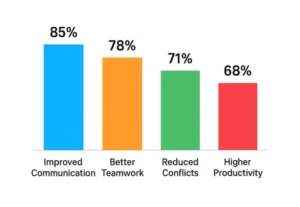
Benefits of Workplace EI Training
When effectively implemented, the EI training can bring significant improvement, which you can measure. The following histogram gives some examples of types of the benefits of successful EI training modules:
Why Are Emotional Intelligence Activities for Groups Effective?
A collective learning experience allows you to grow together, enabling you to understand each participant and manage their aspirations, thoughts, emotional expressions, and feelings effectively. With this, you will create perfect bonding. When you are in group settings, you will be able to observe, practice and develop emotional skills and strategies to manage stressful situations effectively.
Collective Learning Benefits
Circle or group discussions and trust-building exercises allow every participant to make good use of each other’s viewpoints and thoughts. As a participant, you will see how others are able to manage their feelings and situations. You will apply those strategies in your real-life situations.
Workplace and Community Applications
In these activities, you may participate in simulation exercises to learn empathy. You will learn to care about others, to sense other situations, and to assume for yourself how you would feel in their place.
If you participate in a community service program or projects, you will gain exposure to different situations and problems, inculcating compassion and meaningful feelings towards society and individuals.
Conclusion
To lead a successful life in this fast-paced, emerging world, emotional skill development is essential for everyone—relationships and bonding are as crucial as your technical knowledge. It is a bonding and good relationship in society that opens the doors to success. So, each activity we discussed above helps you develop the ability to understand yourself and others’ situations and emotions, and to build connections.
With dedication and genuine interest, everyone in this world can improve their emotional intelligence with consistent practices as discussed above. Simple but powerful, the emotional intelligence activities can bring positive change and improvement in your life and everyone everywhere.
Frequently Asked Questions
Can emotional intelligence be learned at any age?
It is possible to learn at any age; however, the childhood phase becomes easier.
How much time does it take for you to improve emotional intelligence?
With regular practice, you can observe the results in 3-6 months. Lifelong growth continues to come to you, so it does not fade out, but practice should remain the focus.
What’s the easiest way to start building EI?
You may start with emotion vocabulary where you replace fine with specific words or phrases like content, peaceful and such related phrases, for example. Emotion vocabulary increases positivity in your mind, and your mindset about the surroundings becomes stronger.
Do emotional intelligence activities in the workplace do any good for workers, youngsters and adults?
People of all ages, including young adults aged 18 and older, benefit from the activities. Not just teens, but also adults benefit from journaling, mindfulness apps, and peer discussion.
Can these activities help with anxiety?
While anxiety can be a medical condition, it depends on the severity of the issues. Suppose you involve emotion regulation techniques like grounding (strategies or techniques for an individual to reconnect with the present moment and reality) and cognitive reframing exercises. In that case, you may see a significant reduction in the symptoms of anxiety, but it depends on the level of consistency of participation in the exercise.
Postscript
Communities, not just the individuals, benefit from the exercises and activities of emotional intelligence. Children tend to develop greater EI skills if they participate in such a training module at an early phase of life. If made a part of daily life, you may see profound growth. Simple and easy as they may seem, the emotional intelligence activities have great positive effect on the participant.